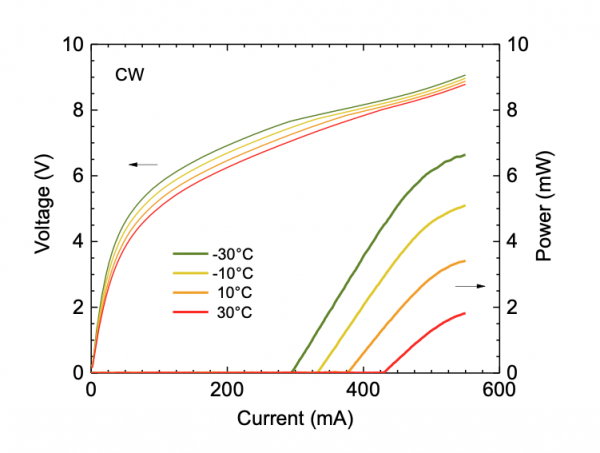

mirSense can manufacture any wavelength in the 10-19 µm range and below are examples of gases that can be measured by spectroscopy at specific wavelengths.
General datasheet presenting the 10-19 µm offer
Application family
|
Wavelength |
Measurable species |
QCL product datasheet when available |
| OH Hydroxyl radical spectroscopy |
~18.8 µm |
~531 cm-1 |
OH radical |
UN0530Q003HNA |
| Fundamental science |
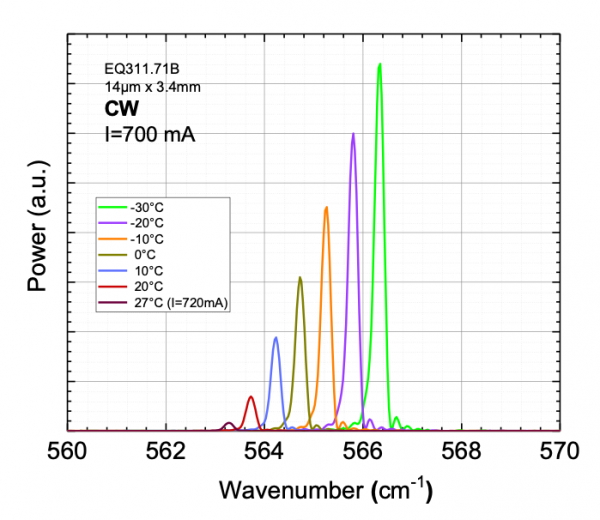
~ 17.7 µm |
~ 565 cm-1 |
|
UN0565C002HNA |
| Carbon emissions |
~ 15 µm |
|
CO2 |
|
|
Fluoro |
~ 10.5 µm |
~ 948 cm-1 |
SF6 Sulfur hexafluoride |
|
| VOC |
~ 13.7 µm |
~ 729 cm-1 |
Toluene |
UN0746C005HNA |
| VOC |
~ 14.4 µm |
~ 694 cm-1 |
Toluene |
|
| VOC |
~ 14.3 µm |
~ 697 cm-1 |
Ethylbenzene |
|
| VOC |
~ 13 µm |
~ 769 cm-1 |
m-Xylene |
UN0746C005HNA |
| VOC |
~ 12.6 µm |
~ 795 cm-1 |
p-Xylene |
UN0746C005HNA |
| VOC |
~ 13.5 µm |
~ 741 cm-1 |
o-Xylene |
UN0746C005HNA |
| Nitrogen |
~ 10.7 µm |
~ 930 cm-1 |
NH3 Ammonia |
|
| Nitrogen |
~ 17.2 µm |
~ 581 cm-1 |
Nitrous oxide N2O |
|
| Nitrogen |
~ 10.6 µm |
~ 941 cm-1 |
N2H4 Hydrazine |
|
| Nuclear |
~ 11.3 µm |
~ 885 cm-1 |
CH3i Methyl Iodide |
UN0885C010HNA |
| Toxic |
~ 11.8 µm |
~ 850 cm-1 |
COCl2 Phosgene |
|
| Toxic |
~ 14 µm |
~ 713 cm-1 |
HCn Hydrogen cyanide |
UN0713C005HNA |
Some publications with our lasers
You may read below a publication about OH radical spectroscopy with a 19µm QCL wavelength from mirSense:
Nicholas M. Kuenning, Nicolas Q. Minesi, Brett A. Honaker, R. Mitchell Spearrin,
THz rotational absorption spectroscopy of the hydroxyl radical at high temperatures using a quantum-cascade laser,
Proceedings of the Combustion Institute,
Volume 40, Issues 1–4,
2024,
105480,
ISSN 1540-7489,
https://doi.org/10.1016/j.proci.2024.105480.
(https://www.sciencedirect.com/science/article/pii/S1540748924002888)
Abstract: A THz-frequency quantum-cascade laser absorption sensing method was developed for quantitative, time-resolved pure rotational spectroscopy of the hydroxyl radical in combustion environments. A systematic wavelength selection process involving consideration of line strength, temperature sensitivity, and spectral interference resulted in the down-selection of a group of rotational OH transitions near 531 cm−1 (15.9 THz). Spectrally-resolved measurements of multiple transitions were achieved using a pulsed quantum-cascade laser (QCL) at a measurement rate of 25 kHz with an integration time of approximately 5µs. A neighboring water line within the scanning range of the laser enables the water spectra to be measured and subtracted, removing the already minimal water interference near the target OH feature. The THz-range sensor was integrated on a high-enthalpy shock tube to validate the line strengths of the selected OH transitions at or near equilibrium in shock-initiated oxidation of argon-diluted ethylene and oxygen mixtures over a range at temperatures between 1500–3500 K. Quantitative species time histories were also measured during chemical non-equilibrium of ethylene and methanol oxidation to demonstrate the capability to resolve transient formation and destruction of OH during combustion. A detection limit of approximately 0.5 ppm-meter was demonstrated. To the authors’ knowledge, this work represents the first laser absorption sensing of the pure rotational spectra of OH at combustion conditions, exhibiting high potential for numerous applications.
Keywords: Hydroxyl; Shock tube kinetics; Laser absorption; THz; Rotational spectroscopy